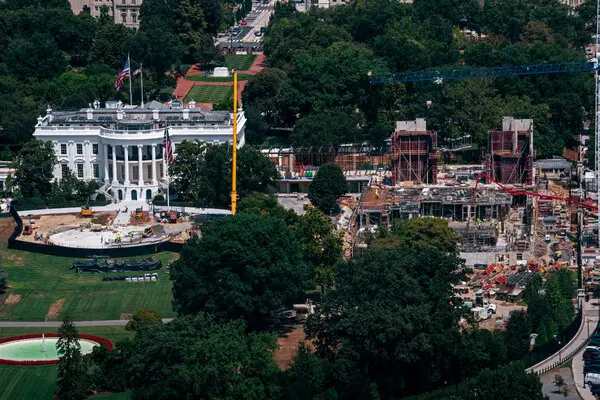
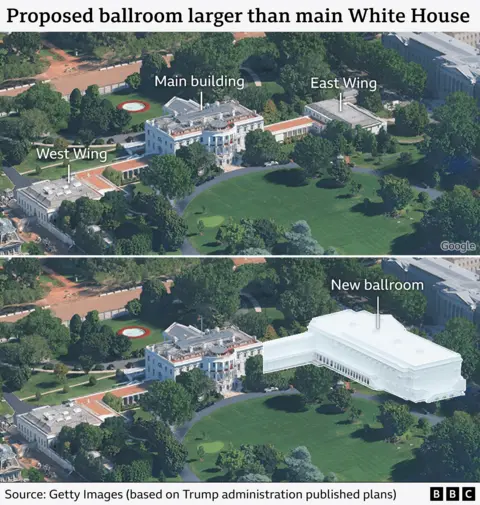
The Trump administration has been ordered to stop construction on President Donald Trump’s $400m (£297m) ballroom at the White House.
A federal appeals court dealt the latest setback to the controversial project on Friday, testing Trump’s presidential authority. He has vowed to appeal to the Supreme Court.
“Whether or not a massive ballroom should be constructed is for Congress to decide and is not a matter for Executive self-help,” the panel’s majority said.
The order upholds a preliminary injunction won by the National Trust for Historic Preservation, which sued after the administration tore down the East Wing last year to begin the project without congressional approval.
“Congress has not ceded unfettered authority to the Executive Branch to dramatically redesign, reshape, and reconstruct the White House — the People’s House — to fit a particular President’s desires,” the panel said.
The three-judge panel, in a 2-1 decision, said: “Each President is a temporary tenant, not the owner, of the White House and its Executive Residence.”
“The President has no – and claims no – constitutionally assigned authority over that property, which is designed and maintained for the use of all Presidents, current and future, and for the American people,” the opinion said.
The administration appealed to the court after a federal judge twice blocked above-ground construction on the ballroom, while still allowing underground work to proceed.
The ruling on Friday upholds the order blocking above-ground construction without congressional approval. The appeals court delayed implementation of its ruling for 14 days to allow the Trump administration to appeal to the Supreme Court.
The BBC has contacted the White House and Department of Justice for comment.
Trump railed against the “horrendous” and “politically motivated” decision on social media, highlighting the dissenting judge’s opinion that the order is “a blatant abuse of discretion”.