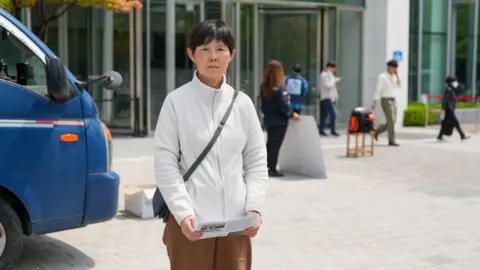
A week before her son died Park Mi-suk asked him to quit his job.
In that time, Park says, her son lost 15kg and often complained of how tired he was.
But Jang Deok-jun refused to quit. He compared his job to being on a seesaw: if he stepped down, his co-workers would struggle to keep going.
The following week, Park found him unconscious and hunched over in the bath.
“We pulled him out and performed first aid. We rushed him to hospital, where they declared him dead.”
Jang died of a heart attack. The state-run insurer that covers healthcare for workers, Comwel, blamed his death on overwork following an investigation.
Park wishes she had noticed Jang’s exhaustion sooner. “I didn’t pay attention to my son’s words, so I lost my son. But I hope others won’t repeat the same mistake.”
Jang died in 2020 but six years on, Park is still fighting to end what she believes is the reason for his death: night-time deliveries.
Jang died as deliveries surged during the pandemic, which was often cited to explain his workload.
But the working conditions for warehouse and delivery workers have been the subject of a growing national debate, with their union claiming that suspected deaths from overwork have continued.
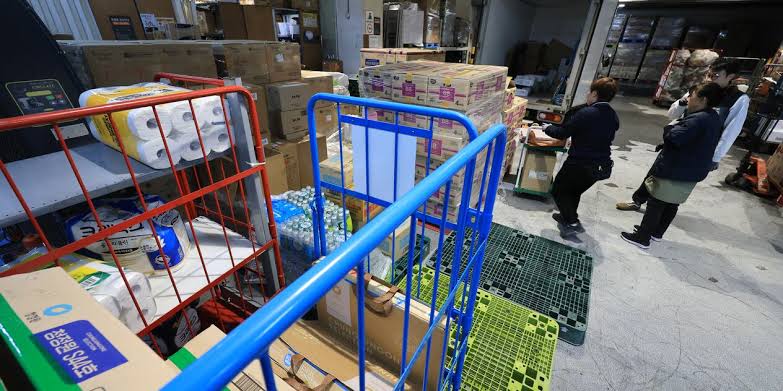
Night-time deliveries have become ubiquitous in hyper-connected South Korea, where shoppers are guaranteed delivery by 07:00 for orders placed before midnight. This convenience is thanks to a huge overnight workforce, from warehouse workers like Jang to delivery drivers.
Several companies compete to offer speedy, cheap deliveries but the biggest is Coupang.
Founded by a Korean-American, it became synonymous with online shopping in South Korea after 2015, when it started offering fresh produce overnight. It has grown to have an unrivalled network of warehouses and delivery trucks, with nearly 100,000 employees across the business.
But increasingly, this industry is under scrutiny.
Between 2020 and May 2026, Comwel ruled that 46 warehouse and delivery workers, including Jang, died of a stroke or heart disease that count as work-related deaths. Jang aside, it’s unclear how many of them worked overnight shifts.
Comwel did not say how many of these cases were also investigated for the role of overwork, which only happens if the family asks for it in their claim. And not every case is referred to Comwel in the first place, so the data can be patchy.
Previously Comwel data suggested that day-time delivery workers died of overwork and accidents at a higher rate than those who work overnight.
But that is now questioned by those who say night-time deliveries are expanding fast, and there is not enough data to fully document their impact yet. The workers’ union also argues that the latter is more harmful to health in the long-term.
Night-time work is a probable cause of cancer globally, according to the UN’s cancer research body. “Not only that, evidence has been accumulating that it also raises the risk of cardiovascular diseases, diabetes and mental illness,” says Kang Mo-yeol, professor of occupational medicine at the Catholic University of Korea.
South Korea doesn’t limit overnight working hours, unlike in the UK, where night-time delivery drivers cannot work more than 10 out of 24 hours.
The Korean delivery workers’ union called for a ban on overnight deliveries in 2025, but the union for Coupang’s drivers says nearly all of their members prefer working at night.
Some have children, elderly or ill family members to care for during the day and, more importantly, it pays better.
“I can’t do this for life because it eats away at my body,” says Kim, a Coupang driver on a sub-contract, who did not want to share his real name. But he adds that his monthly salary of around 7m won ($4,600; £3,430) – nearly double the national average – makes it worth it.
When the BBC met him at 22:00, he had already loaded his truck for the first round of deliveries.
Driving through the narrow streets of Incheon city, west of the capital Seoul, he explains that he works from 21:00 to 07:00, five to six days a week.
His schedule does not allow for a break. Every time the truck stops, he runs, package in hand. Nearly all drivers are paid by the number of packages they deliver and if they fail to make all deliveries by 07:00, they risk losing their “territory” to a competitor, he says.
At first, his pregnant wife was scared he might fall asleep at the wheel. But he is used to it now, he insists, and he finds it easier to navigate the night’s empty streets.
“We choose to deliver overnight for the money,” Kim says. The way he sees it, those who are saying overnight deliveries should stop because they affect his health are ignoring the choice he has made.